
Publication Date
4-2025
Files
Download Full Text (371 KB)
Abstract
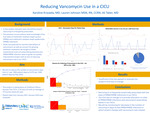
Introduction: In the cardiac intensive care unit (CICU) empiric vancomycin is frequently prescribed. This practice occurs without wide knowledge of the true rates of methicillin resistant staph aureus (MRSA) and methicillin resistant staph epidermidis (MRSE) infections. Given the potential for harmful side effects of vancomycin as well as concern for growing antibiotic resistance we sought to better characterize local unit prescribing practices and MRSA/MRSE infection rates to guide our quality improvement project with an aim of reducing vancomycin use in our CICU. Methods: This project is taking place at Children’s Mercy Kansas City CICU, a 24 bed unit with an average of 274 pump cases per year. Patient data from January 2021-January 2023 was analyzed. There were approximately 20-60 vancomycin days per month with a center line of 0.1, indicating that over that time frame, 10% of the patient days were vancomycin days. In 2021 there were 111 orders for Vancomycin. Using a Pareto chart, we found that a majority (52) of Vancomycin orders were for fever alone. We analyzed all positive cultures in 2021 and of the 111 vancomycin orders there were only 11 positive MRSA/MRSE infections for which Vancomycin was prescribed as a full treatment course. We aim to reduce the number of vancomycin days from 0.1 per 1000 patient days to 0.075 per 1000 patient days by May 2025. Given the mismatch between prescribing habits and true infection rates, our first test of change will be to provide education regarding MRSA/MRSE infection rates in the CICU and current prescribing habits. Additionally, we will ask that providers not order vancomycin if a patient has a fever alone without hemodynamic instability, without high or increasing inflammatory markers, has not had a heart transplant, is not on extracorporeal membrane support or a ventricular assist device or is not immunocompromised. As a balancing measure we will track MRSA/MRSE positive cultures that did not receive vancomycin prior to culture results. Results: Insufficient time has passed to evaluate the project’s first test of change. Conclusions: Vancomycin is frequently empirically prescribed with low rates of MRSA/MRSE infections in our CICU. Our first test of change is to provide education on rates of MRSA/MRSE infections and vancomycin prescribing habits in our CICU. We will be monitoring for decrease in the number of vancomycin days as well MRSA/MRSE infections in which empiric therapy with vancomycin was missed.
Disciplines
Critical Care | Pediatrics
Recommended Citation
Krzywda, Karoline; Johnson, Lauren; and Taber, Allison, "Reducing Vancomycin in a CICU" (2025). Posters. 451.
https://scholarlyexchange.childrensmercy.org/posters/451



Notes
Presented at the PC4/PAC3 Spring 2025 Conference; Washington, DC; April 14-16, 2025