
Publication Date
9-2025
Files
Download Full Text (882 KB)
Abstract
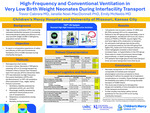
Background: Very low birth weight (VLBW) neonates (≤1500 grams) transported across neonatal facilities often require advanced respiratory support, including high-frequency ventilation (HFV). While HFV use in this setting has increased, data evaluating its safety and efficacy in the VLBW population remain limited. We hypothesized that HFV will provide a safe modality to transport sick VLBW infants. Objectives: To present a comparative experience of safety and efficacy of HFV and CV in VLBW neonates during interfacility transport. Methods: We retrospectively reviewed neonates ≤1500g who received invasive ventilation during interfacility transport by our transport team between January 2019 and December 2022. HFV was delivered using ……, while conventional ventilation (CMV) was delivered via ………Demographic, clinical, transport characteristics, ventilator settings, and respiratory variables were collected. We compared primary outcomes under three categories: (1) ventilatory stability assessed by hypocarbia (pCO2 < 35) or hypercarbia (pCO2 >55) at the end of transport; (2) respiratory complications during transport; and (3) transport mortality. Results: A total of 122 neonates met inclusion criteria; 37 (30%) received HFV and 85 (70%) received CV. Neonates transported on HFV were more likely to have been born at younger gestation, transferred at ≥24 hours old, have a history of PROM or PPROM, require higher FiO2 and have higher pCO2 levels at the transferring facility (Table 1). Upon arrival at the accepting facility, both groups had comparable admission pCO₂, pH, blood pressure, and oxygenation, despite higher FiO₂ and more frequent pressor use in the HFV group. No cases of pulmonary hemorrhage, pneumothorax, or death occurred during transport. HFV patients had longer ground and total transport times. Chest radiographs showed a non-significant trend toward more frequent hypo-/hyperinflation in the HFV group (Table 2). Conclusion: Our retrospective study suggests that both HFV and CV are associated with safe transport and comparable immediate post-transport physiological outcomes in VLBW neonates requiring interfacility transport with invasive ventilation. Despite being more critically ill requiring higher ventilatory support, neonates transported on HFV achieved similar ventilatory stability without increased risk of respiratory complications or mortality. These findings support the feasibility and safety of HFV during neonatal transport of VLBW infants. Future studies will define the clinical parameters that guide preference of HFV vs. CMV for choice of respiratory support. ,
Disciplines
Pediatrics
Recommended Citation
Cabrera, Trevor; Noel-Macdonnell, Janelle R.; and McNellis, Emily, "High-Frequency and Conventional Ventilation in Very Low Birth Weight Neonates During Interfacility Transport" (2025). Posters. 482.
https://scholarlyexchange.childrensmercy.org/posters/482



Notes
Presented at the Midwest Society for Pediatric Research 2025 Annual Scientific Meeting; Chicago, IL; September 17-19, 2025.