
Publication Date
11-2025
Files
Download Full Text (323 KB)
Abstract
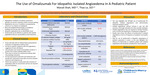
Introduction Angioedema manifests as localized, asymmetric, nonpruritic cutaneous and/or mucosal swelling. The two main clinical forms are histaminergic and bradykinin mediated angioedema. Histaminergic is more common and presents with hives, and responds to antihistamines, steroids, and epinephrine. Bradykinin mediated angioedema lacks hives and does not respond to these therapies. Ten percent of patients with recurrent angioedema have isolated angioedema without urticaria. Case Description A previously healthy 8-year-old male presented initially to the ED evaluation of isolated lip swelling and no other systemic symptoms. There was no exposure to new foods, medications, or illness symptoms. He received anti-histamines and steroids with improvement in his symptoms and referred to Allergy clinic for further evaluation. Lab evaluation with CBCD, BMP, LFTs, inflammatory markers, thyroid studies, ANA, hereditary angioedema, and tryptase were within normal limits. He continued to have recurrent episodes of swelling despite high dose second-generation antihistamines and H2 antagonist. He was started on omalizumab for idiopathic isolated angioedema, with resolution of his symptoms after the second dose. He has been able to stop all anti-histamines without recurrence of symptoms. Discussion This case highlights the off-label use of omalizumab for idiopathic isolated angioedema and demonstrates improvement in symptom control. Isolated angioedema in the absence of urticaria is rare but still warrants a thorough evaluation as management may differ. Isolated angioedema can be difficult to treat as it may not respond to standard therapy. Omalizumab may be effective for these patients and can be considered as a treatment option for recurrent idiopathic isolated angioedema.
Disciplines
Allergy and Immunology | Pediatrics
Recommended Citation
Shah, Manali and Le, Thao, "The Use of Omalizumab For Idiopathic Isolated Angioedema In A Pediatric Patient" (2025). Posters. 494.
https://scholarlyexchange.childrensmercy.org/posters/494
Restricted
This document is restricted to only CMKC staff. Sign in using a CMKC email to access the full text.



Notes
Presented at the American College of Allergy, Asthma & Immunology (ACAAI) 2025 Annual Scientific Meeting; Orlando, Florida; November 6-10, 2025.