
Publication Date
4-2026
Files
Download Full Text (400 KB)
Abstract
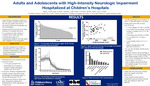
Introduction: Children with high-intensity neurologic impairment (HINI) account for a sizeable proportion of inpatient resources. As survival into adulthood for children with medical complexity increases, children’s hospitals will likely admit adults with HINI. Understanding adult HINI hospitalization patterns is necessary to develop effective care strategies for this population. Objective: Compare characteristics of adults and adolescents with HINI hospitalized at children’s hospitals and describe hospital-level variation in hospitalizations for adults with HINI. Methods: This retrospective cross-sectional study included discharges of patients with HINI aged 12-29 years from 41 children’s hospitals in the Pediatric Health Information System between 2022-24. Hospitals were excluded if birthing encounters were identified. Discharges were categorized by age: adolescents (12-17 years) and adults (18-29 years). Chi-square and Wilcoxon Rank-Sum tests compared hospitalization level characteristics (i.e., intensive care use, hospital length of stay, in-hospital mortality, and costs) across the two age groups. Hospital-level variation was described using the percentage of included HINI discharges that were adults and correlated with hospital volume of included HINI discharges using Pearson’s coefficient. Results: There were 136,290 discharges included; 23.6% were adults. Compared to adolescents, adults were more likely to have >1 HINI category (41.1% vs 33.9%), a co-morbid non-neurologic chronic complex condition (72.5% vs 58.5%), and technology use (49.2% vs 37.8%) (Table). Adults had slightly longer length-of-stay, similar ICU use, similar mortality, and higher hospitalization costs (Table). There was substantial hospital-level variation in the percentage of HINI hospitalizations that were adults (range 0.0% to 35.7%), which was correlated with hospital volume of all HINI discharges aged 12-29 years (p< 0.01). Conclusion: Adults with HINI were more complex and incurred longer hospitalizations and greater costs than their adolescent counterparts. Hospital-level variation in adults with HINI hospitalized at children’s hospitals was correlated with hospital volume of HINI discharges and may result from differences in the transition processes between institutions. Future studies should seek to understand optimal transition timing and care setting for adult HINI patients.
Disciplines
Pediatrics
Recommended Citation
Maloy, Charles; Hall, Matt; Thomson, Joanna; LePichon, Jean-Baptist; and Puls, Henry T., "Adults and Adolescents with High-Intensity Neurologic Impairment Hospitalized at Children’s Hospitals" (2026). Posters. 514.
https://scholarlyexchange.childrensmercy.org/posters/514



Notes
Presented at the 2026 Pediatric Academic Societies (PAS) Annual Meeting; Boston, MA; April 24-27, 2026.