
Publication Date
5-2026
Files
Download Full Text (1.2 MB)
Abstract
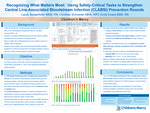
Background: Our CLABSI improvement team developed high-risk rounding processes on the Hematology/Oncology unit. Expanding this model to additional Med/Surg units was challenging due to limited staffing and time-intensive tasks required during rounds. Concurrently, CLABSI rates across other Med/Surg units increased, necessitating a scalable approach. Objectives: Apparent Cause Analysis (ACA) review in Med/Surg units identified an opportunity to strengthen surveillance by engaging Vascular Access subject-matter experts. Our proactive high-risk rounds pilot led to CLABSI rate reduction. The objective was to expand service coverage without compromising established high-risk rounding quality standards. Our goal is to assess > 90% of central lines in Med/Surg through daily high-risk rounding. Methods: We applied the SPS Safety Performance Plan: Hospital Improvement Work Activity to systematically evaluate existing high‑risk rounding processes. Non–safety‑critical tasks were identified, and an improvement team assessed opportunities to streamline, retire, or reassign. This analysis enabled breakthrough changes, including engaging virtual nurses to deliver CLABSI education. Utilizing Plan‑Do‑Study‑Act framework, we tested process modifications and refined workflow to support expansion beyond the Hematology/Oncology/BMT unit. Rounding extended first to Med/Surg areas with higher CLABSI rates, allowing resource prioritization and validating scalability of the revised model. Results: Hem/Onc CLABSI rates decreased from 2.70 to 0.64 per 1,000 line days (July–October 2025 vs. November 2025–January 2026). Med/Surg CLABSI rates declined from 1.64 to 1.21 per 1,000 line days, concurrent with expanding CLABSI rounding to all Med/Surg units by January 2026. On average, 88% of central‑line patients received high-risk rounds. The proportion of in-room assessment times under 15 minutes increased from 33.5% to 54.8%. Conclusions/Implications: Prioritizing safety-critical tasks strengthened continuous monitoring and enabled earlier risk mitigation through subject‑matter expert support. By reallocating non-critical tasks to existing hospital rounds and shifting education to virtual nursing, rounding across all Med/Surg units expanded. Frequent rounding supports adherence to interventions and lowers CLABSI risk.
Disciplines
Pediatrics
Recommended Citation
Bergerhofer, Lacey; Schneider, Christian Anthony; and Evans, Emily, "Recognizing What Matters Most: Using Safety-Critical Tasks to Strengthen Central Line-Associated Bloodstream Infection (CLABSI) Prevention Rounds" (2026). Posters. 523.
https://scholarlyexchange.childrensmercy.org/posters/523



Notes
Presented at the Solutions for Patient Safety (SPS) Spring 2026 Learning Session; St. Louis, Missouri; May 13-15, 2026.
This poster won the People's Choice Award.