These slides have been presented at a meetings in Children's Mercy and around the world. They represent research that was done at the time they were created, and may not represent medical knowledge or practice as it exists at the time viewers access these slide presentations.
-
Decreasing Unplanned Extubations by Taping Technique & Creating a Culture of Safety
Karishma Rao, Beckie Palmer, Christopher R. Nitkin, Christian Anthony Schneider, Brandy Huitt, Molly Terhune, Ashley Orwick, Dianne Wilderson, Sarah Carboneau, Jenny McKee, Kerrie A. Meinert, and Eugenia K. Pallotto
Describes strategies used to decrease the unplanned extubation rate in the Level IV neonatal intensive care unit to less than 1.0 event per 100 ventilator days by December 2018.
-

Mutant p53 Depletion by Natural Compounds
Mohamed A.A. Alalem, Sana Farooki, and Tomoo Iwakuma
The goal of this research project is to identify and characterize potentially novel antineoplastic agents that could specifically degrade conformational mutP53 protein in cancer cells. We concluded that treatment of cancer cells with curcumin or PLINH compounds inhibit proliferation of cancer cells in a DNAJA1-misfolded mutp5-dependent manner. Delineation of the exact mechanism through which curcumin and PLINH exert their anti-cancer effects could pave the way for promising novel preventive and therapeutic modalities for cancer.
Erratum/Corrigendum:
Corrigendum submitted by Mohamed Alalem
Error on slide 6: Figure 4 updated in GREEN. Cell line is HT29 not Mia-paca-2.
Access Restricted by Mohamed Alalem and Tomoo Iwakuma.
-

The Effect of Antihypertensive Dose on Blood Pressure Control in Children with Chronic Kidney Disease
Benjamin A. Matta
This presentation describes a study to determine the effect of antihypertensive dosing on blood pressure control in children with chronic kidney disease. The original version of this presentation is a prezi show at https://prezi.com/view/4qluDL1gMKFELOf1nLVA/
-

The Physiology and Hormonal Control of Calcium, Phosphate and Vitamin D
Uri Alon
Describes calcium, phophate, and vitamin D in the context of pediatric rickets.
-

"Making Learning and Teaching Fun Again!" - Strategies to Improve Learner Engagement and Retention
Kadriye O. Lewis, Jennifer Colombo, Christian Lawrence, Kenya McNeal-Trice, and Mark Chandler
This presentation describes and demonstrates different strategies for medical education.
-
Screening Pediatric Patients for Readmission Risk
Sarah Bradshaw and Blair Buenning
Podium Presentation of HARRPS Research Project and Findings
-
Early Identification of Depression in Patients with Pediatric Epilepsy
Erin Day Fecske
Describes a program to assess adolescent patients with epilepsy for depression, and to refer these patients to mental health services when appropriate.
-
Screening Pediatric Patients for Readmission Risk
Sarah Bradshaw, Blair Buenning, and Anita Powell
Presentation of Quality Improvement & Research Project of HARRPS Tool at the Children's Mercy Hospital Patient Care Services Research Ground Rounds
-
Age Appropriate Assisted Airway Clearance Techniques for Children
Christopher M. Oermann
Describe normal airway clearance and the disease processes for which assisted airway clearance therapy is indicated. Explain the physiologic rational for and data supporting use of various assisted airway clearance techniques used among children. Develop an age and diagnosis appropriate airway clearance plan for a child with impaired airway clearance.
-
Alternative Care Models for Management of Diabetes
Sarah Tsai
Describes effort to improve A1C in teens using motivational interviewing vs. traditional patient/provider interaction in real-world clinic setting.
-
Screening Pediatric Patients for Readmission Risk
Sarah Bradshaw and Blair Buenning
Kansas City Nurse Research Consortium Forum: Presentation on HARRPS Research Project
-
Screening Pediatric Patients for Readmission Risk
Sarah Bradshaw, Blair Buenning, and Anita Powell
Overview of the HARRPS Research Project
-

Save the Pharmacy Piggy Bank: Managing Mega High-Cost Drugs
Richard K. Ogden Jr., Jerame Hill, and Sam Abdelghany
-
Intractable Diarrhea and Steatorrhea after Initiation of Ivacaftor/Lumacaftor in a Child with Cystic Fibrosis and a History of Meconium Ileus and Small Bowel Resection
Christopher M. Oermann
Background.LB is a 6 year old with pancreatic insufficient CF> Delivered at 35 week EGA and diagnosed with meconium ileus. Segmental resection of 7 cm of the distal ileum and ileostomy. Ileostomy take-down at 8 weeks of age. Intermittent gastrointestinal issue and poor growth early in life.
-
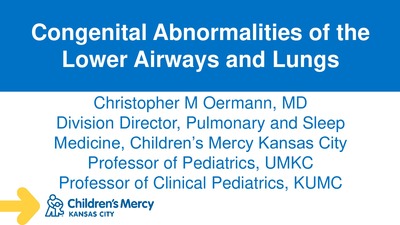
Congenital Abnormalities of the Lower Airway and Lungs
Christopher M. Oermann
Goals and Objectives. Participants will be able to: Describe the 5 stages of fetal lung development. Summarize the prenatal identification and management of congenital abnormalities of the lower airways and lung (CALA). Explain the classification of CALAL. Compare the clinical characteristic, pathology and management of common CALAL. Discuss the long term prognosis of CALAL.
-
Patterns of use of non-ambulatory care services in patients with attention-deficit/hyperactivity disorder
July K. Jean Cuevas, Hongying Dai, and Suman Sahil
Background:
ADHD affects 1 out of 11 children (ages 4-17)
Cost of psychiatric disorders: – Limited investigation in children and adolescents. – Limited studies on economic burden of ADHD in the US
A recent study showed increased cost of healthcare in $USD for patients with ADHD in United States.
Hypothesis: – Costly non-ambulatory services contribute to this discrepancy
Objective: To compare non-ambulatory health care utilization patterns of patients with and without ADHD in a large socioeconomically, racially and geographically diverse population.
Methods:
Retrospective review of data from Cerner Health Facts ®.
A total of 190,365 patients with ADHD and 131,473 patients without ADHD who received non-ambulatory care across the United States.
– Ages 3-19 years
– Three year period (2014-2016)
4,000 patients on each group
Looking at the most expensive aspects of care
Statistical analysis
: – Two-sided independent t-tests for continuous variables.
– Chi-square or Fisher's exact test for categorical variables.
Conclusion: Non-ambulatory care use by children with ADHD is likely to be the high cost services; patients are likely to be admitted and stay longer in the hospital
-
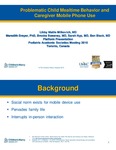
Problematic Child Mealtime Behavior and Caregiver Mobile Phone Use
Libby Milkovich, Meredith Dreyer, Brooke Sweeney, Sarah Nyp, and Benjamin Black
TITLE: Problematic Child Mealtime Behavior and Caregiver Mobile Phone Use
BACKGROUND Problematic mealtime behaviors (PMB) (externalizing behavior at mealtime) have been seen anthropologically when adult caregivers are absorbed in their mobile phones. Parents with mobile phone problematic use (MPPU) are more likely to be absorbed in a mobile device. Use of mobile devices interrupts personal interactions which may cause children to engage in more externalizing behavior to gain attention of the caregiver. MPPU may also be seen among parents attempting to be distracted from a child’s problematic behaviors. Neither the correlation of MPPU to PMB, nor the frequency of PMB to perceived impairment of problem behavior have been quantitatively studied.
OBJECTIVE Evaluate correlation of caregiver MPPU and child PMB to improve understanding of the possible implications of caregiver MPPU
METHODS Participants included caregivers of children ages 2-8 years being seen in a pediatric hospital clinic. Participants completed a survey on an iPad via REDCAP. The survey included demographics (caregiver/child age, gender, race/ethnicity; child BMI; caregiver level of education, a validated measure for caregiver MPPU (Mobile Phone Problematic Use Scale; MMPUS) and a validated measure for perception of child PMB (Meals in our Household; MIOH). MIOH includes frequency of PMB and perceived impairment from PMB. Measures are continuous variables. Spearman correlation was used for the studied variables and possible confounding variables. Significant confounding variables were evaluated in a regression model.
RESULTS 100 caregivers (mean age 32.9 years, 65% white, 20% ≤ high school completion) participated. Correlation of MIOH problematic behavior total with MMPUS was significant (p=.004, r=0.289). MIOH perceived impairment from PMB had stronger correlation with MMPU (p=<.001, r=.333). Significantly correlated caregiver variables with MPPU include younger age (p=.017, r=-0.241) and gender F>M (p=.005). No significant caregiver variables noted for PMB. Younger child age was significantly correlated with PMB (p=.007, r=-.274). No significant differences in child variables for MPPU. Significant variables were evaluated in regression a model, and MPPU and PMB remained significant.
CONCLUSION Correlation was found between MPPU and PMB. Correlation was stronger when measure of perceived impairment was evaluated. This suggests that caregivers with increased MPPU perceive behavior as more problematic. Improving the understanding of the negative correlation of caregiver MPPU with PMB necessitates pediatricians facilitating conversations with caregivers about this relationship and strategies to ameliorate MPPU during mealtime.
-
Implementation of a Guideline-based Non-tuberculous Mycobacteria Management Algorithm
Christopher M. Oermann
NTM in CF. NTM are ubiquitous environmental organisms that can cause chronic pulmonary infection. Prevalence among CF patients is increasing. 1-3% in the earliest study reported in 1984. CF Registry with average of 12% but significant range (0-28%). 32.7% reported among patients less than or equal to 40 years in Colorado. Generally categorized as “slow growers” and “rapid growers”.
-
ABCs of Safe Sleep
Alyson Hill RN, Jennifer Markey RN, Bailey Ritter RN, Ashley Smith RN, and Aaron Smithson RN
PICO Question
Does education and teaching to parents and family regarding safe sleep practices increase the compliance of safe sleep for infants 0-12 months on 4 Sutherland compared to the current practice?
Aim Statement
The objective of the evidence based practice project is to increase Safe Sleep compliance by improving education given to parents and family from 20% to 90% by February 2018
-

Baby Got BAC
Tina Histand BSN, RN; Heidi Mustapich BSN, RN; Brittany Parks RN; Mallory Potter BSN, RN; and Melanie Traynham RN
PICO Statement
• Population: 6 Henson patients who qualify for Safe Sleep Practices according to the Safe Sleep Policy.
• Intervention: Signs will placed in high patient care areas to provide awareness and reminders to 6 Henson patient caregivers of correct safe sleep practices.
• Comparison: Current standard of care
• Outcomes: Increased compliance with safe to sleep practicesAim Statement
The objective of this evidence based practice project is to increase Safe Sleep compliance on the 6 Henson unit by 10% by March of 2018
-

Chasing Never: Unplanned Extubation
LeeAnna Gaspers BSN,RN; Brittney Gerber BSN,RN; Madison Hersma BSN,RN; Erin Keith-Chancy BSN,CCRN; Audrey Knodell BSN,RN; Jordan Miller BSN,RN; Liz Morrow BSN,RN; Tara Otterson BSN,RNC; Chantal Rogers BSN,RN; and Abby Slaven BSN,RN
PICO Question
• P:In the Intubated neonate
• I: can the bundling of potentially best practice recommendations (tube location documentation, 2-person handling, and management of positioning and secretions) and standardized hourly assessment with documentation of compliance
• C: current standard of practice
• O: decreased unplanned extubationsAim Statement
Decrease the rate of unplanned extubations in the ICN from 1.38/100 ventilator days in 2016 to 1 event/100 ventilator days in 2017.
-
ED Staff Morale
Madison Wilkins RN, Tonya Cross RN, Brittany Schmalzbach RN, Noah Olla RN, Fred Richards RN, and Emily Pendleton RN
PICO Question
PICO Question & Aim Statement
• (Population, Intervention, Comparison, Outcomes Measures)
• P: ED Nurses and Support Staff
• I: Huddle Recognition and prizes
• C: No recognition
• O: Improved nursing morale
To increase the median morale of nursing and support staff from 74% to 80% as measured by Daily Pulse by March of 2018
-
ICN Flu Vaccine Cocooning
Allison Bauer BSN, RN; Brittany Wolter BSN, RN; Jonathan Rind BSN, RN; Maggie Butaud BSN, RN; Sarah Dumovich BSN,RN; Tori Weishaar BSN, RN; and Karli Wittenbach BSN, RN
PICO Question
P (Population): Registered nurses in the CMH Intensive Care Nursery providing patient care.
I (Intervention): Electronic documentation of parent flu vaccine status. Include vaccine status reminder in pod huddle.
C (Comparison): Current practice
O (Outcome): Increase the percentage of families receiving the flu-vac
Aim Statement
The objective of this evidence based practice project is to increase the percentage of families receiving the flu vaccine from 83% to 85% by March of 2018
-

PICU Patient Satisfaction
Kaitlyn Enochs BSN, RN; Jonathan Foley BSN, RN; Tara Goodman BSN, RN; Abby Haupt BSN, RN; Chelsea Koerkenmeier BSN, RN; Allison Mills BSN, RN; Kara Mishler BSN, RN; Madison Myers BSN, RN; Michelle Noykhovich BSN, RN; Sophia Poplin BSN,RN; Austin Reyes BSN, RN; Kylie Stottlemyre BSN, RN; Sarah Swift BSN, RN; Danielle Warner BSN, RN; Emily Zimmerman BSN, RN; Brooke English MSN, RN, CCRN; and Katherine Hoffman BSN, RN
PICO
PICU secretaries and parents will be able to increase the number of completed parent satisfaction surveys compared to current actions and supports.
Aim Statement
- To increase rate of completed parent survey by 5%, as measured by the number of surveys submitted each quarter by January 2018
- To have 10% response rate to surveys for patients that have been in the PICU for 30 days or greater.
-
Safe Baby
Hannah Burger BSN, RN; Samantha Cockrell BSN, RN; Shauni Lawrence BSN, RN; Shae McGinnis BSN, RN; Christina Montgomery RN; and Elizabeth Taylor RN
PICO Question
P: 4 Henson and 5 Sutherland patients who qualify for Safe Sleep Practices according to the Safe Sleep Policy.
I: Creating a useable checklist to be completed with each infant and each shift change
C: Current standard of care
O: Increased compliance with safe to sleep practicesAim Statement
The objective of this evidence based practice project is to increase Safe Sleep compliance from 50% to 65% on 4 Henson and 5 Sutherland by February 1, 2018.