
Publication Date
3-2026
Files
Download Full Text (503 KB)
Abstract
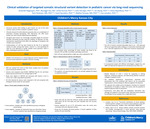
Introduction: Structural variants (SVs) leading to gene fusions are one of the most common classes of driver mutations in pediatric cancer. Clinical SV detection relies on a combination of techniques including karyotyping, FISH, microarray and RNA fusion testing, and, more recently, optical genome mapping. SV detection via long-read genome sequencing (lr-GS) offers the advantage of breakpoint and complex event resolution; however, its implementation has been limited by the lack of an optimized somatic SV caller, among other factors. Here we describe the clinical validation of lr-GS for targeted somatic SV detection in pediatric cancer using Severus, a newly available somatic SV caller for lr-GS. Methods: DNA was isolated from fresh or fresh frozen samples from 34 pediatric cancers (26 heme and 8 solid) previously tested clinically for SVs, 28 of which were positive for clinically relevant (i.e., oncogenic) SVs (crSVs) expected to result in a gene fusion. The estimated tumor content for these cases, per pathology review, was 25-98%. Briefly, libraries were prepared using PacBio’s SMRTbell Prep Kit 3.0, and Revio sequencing was performed to an average depth of 30x. Reads were aligned to GRCh38 and processed with Severus v1.6.0 in ‘tumor-only’ mode. Data filtering parameters included a pediatric crSV gene-focused panel , a minimum supporting read count of 4, and the location of the breakpoint relative to the nearest gene. All crSVs detected by Severus were inspected in IGV and compared with orthogonal clinical results for each patient. To establish the assay’s limit of detection, DNA from a neoplastic sample with a crSV was diluted at different ratios with DNA from the same patient’s germline sample. Assay precision was assessed by sequencing the same sample with a crSV across two different runs performed on different days. All resulting data was analyzed as above. Results: Severus detected 25 out of 25 crSV-positive cases that were above the limit of detection established for this assay (30% tumor); the results were concordant with prior laboratory testing, leading to an accuracy of 100%. In some cases, the breakpoint resolution offered by lr-GS identified additional rearrangement complexity that helped clarify orthogonal test results. Across the 34 samples (28 positive + 6 negative), no false positive SVs were identified, yielding an analytical specificity of 100%. In the dilution sample (84% tumor), the SV remained detectable down to an ∼13% observed VAF, leading to a conservative reporting cutoff at ~15% VAF (supportive of the 30% tumor minimum requirement). The assay demonstrated 100% precision, as a re-sequenced sample processed with different technologists, reagent lots, and SMRT cell detected the expected crSV consistently across both runs. Conclusion: Reliable detection of crSVs is crucial for supporting or refining diagnoses, predicting the prognosis, and determining effective treatment strategies for pediatric cancer. The validation performance characteristics presented here demonstrate that Severus can be successfully implemented in clinical settings for effective targeted crSV detection. This approach also enables precise breakpoint resolution for improved interpretation of complex or cryptic crSV events, with the potential to expand from a targeted assay to a genome-wide SV assessment tool. Furthermore, lr-GS offers the benefits of SNV and methylation information that, although not explored in the present study, hold great future potential for additional profiling of these samples from a single data source.
Disciplines
Medical Genetics | Oncology | Pediatrics
Recommended Citation
Nagarajan, Aravindh; Yoo, Byunggil; Farrow, Emily; Herriges, John; Zhang, Lei; Repnikova, Elena; Pastinen, Tomi; Saunders, Carol J.; Farooqi, Midhat; and Lansdon, Lisa, "Clinical validation of targeted somatic structural variant detection in pediatric cancer via long-read sequencing" (2026). Posters. 499.
https://scholarlyexchange.childrensmercy.org/posters/499



Notes
Presented at the 2026 Annual Clinical Genetics Meeting (ACMG); Baltimore, Maryland; March 10-14, 2026.