
Publication Date
3-2026
Files
Download Full Text (8.4 MB)
Abstract
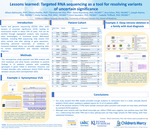
Our study demonstrated the utility of RNA studies in providing sufficient evidence to reinterpret VUS in a small cohort of clinically diverse pediatric patients who received ES/GS-based testing. Fifteen patients (68%) received an updated clinical report. Notably, in 59% the RNAseq data resulted in a molecular diagnosis. Moreover, ~47% of our positive variants were not located at splicing junctions, and therefore, would most likely not be flagged as a likely candidate in ES/GS analysis pipelines. While most variants with low TPM in blood failed, two positive variants had TPM less than 0.1, indicating that while TPM values can help narrow down which variants could be reflexed to targeted RNAseq, these values and in silico splicing predictions have significant limitations. As the cost of sequencing continues to decrease, findings of this diagnostic study demonstrate that the ability to perform targeted RNAseq concurrently with DNA sequencing represents an important advancement in genetic testing by improving classification of variants, therefore, improving the diagnostic yield.
Disciplines
Medical Genetics
Recommended Citation
Kalinousky, Allison; Paolillo, Vitoria; Del Viso, Florencia; Repnikova, Elena; Cohen, Ana S A; Alaimo, Joseph; Farrow, Emily; Saunders, Carol J.; and Thiffault, Isabelle, "Lessons learned: Targeted RNA sequencing as a tool for resolving variants of uncertain significance" (2026). Posters. 502.
https://scholarlyexchange.childrensmercy.org/posters/502



Notes
Presented at the 2026 Annual Clinical Genetics Meeting (ACMG); Baltimore, Maryland; March 10-14, 2026.