
Publication Date
3-2026
Files
Download Full Text (1.1 MB)
Abstract
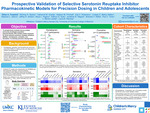
Background: Selective serotonin reuptake inhibitors (SSRIs) are commonly prescribed to children and adolescents with anxiety and depression. However, their clinical use is complicated by marked interindividual variability in exposure, which contributes to differences in treatment response and side effects. Further, SSRIs are commonly dosed using a trial-and-error approach. Model-informed precision dosing could improve treatment outcomes, yet existing SSRI population pharmacokinetic (PK) models have not been prospectively validated and may not generalize to pediatric patients. This study aims to evaluate how accurately these models predict exposure for three SSRIs—escitalopram (ESC), sertraline (SRT), and fluoxetine (FLX)—and refine them to develop tools for dose individualization. Methods: This is an open-label prospective study with dense PK sampling in participants (6-18 years old) prescribed ESC, SRT, or FLX at steady state. Following two weeks of adherence monitoring, participants complete a 24-hour PK study visit where ≤18 blood samples are collected across the dosing interval to measure SSRI plasma concentrations by liquid chromatography mass spectrometry. Published models are implemented into NONMEM to generate individual predicted concentrations from observed trough concentrations to mimic therapeutic drug monitoring. The models are considered validated if the mean ratios of predicted-to-observed Cmax, AUC24, and clearance were within 0.8-1.25. Results: A total of 8 ESC, 8 SRT, and 3 FLX/norfluoxetine (NFLX) models were included for validation. There were 4 ESC, 2 SRT, and 11 FLX/NFLX participants with measured concentrations from interim analysis. Model validation showed 5/8 (63%) of ESC, 0/8 of SRT, and 1/3 (33%) FLX/NFLX models (both parent and metabolite) met full acceptance criteria for all three endpoints, with some models meeting partial acceptance criteria (Figure). Conclusions: Prospective external validation shows several models met the a priori validation criteria for the ESC and FLX/NFLX cohorts. Additional participants in each drug cohort are needed to verify the models are fit for purpose. These findings provide a foundation for future model refinement and suggest that model-informed precision dosing could reduce trial-and-error prescribing and improve SSRI tolerability and efficacy in youth.
Disciplines
Pediatrics
Recommended Citation
Poweleit, Ethan A.; Sparks, Whitney MS; Koertje, Catherine; Pritchett, Addison MS; Robertson, Gail; Malloy-Walton, Lindsey; Stancil, Stephani; Strawn, Jeffrey R.; Pagano, Alexa L.; Kyler, Kathryn; Wagner, Jonathan B.; Retke, Brandon; Toren, Paul C.; Leeder, J Steven PharmD, PhD; and Ramsey, Laura B., "Prospective Validation Of Selective Serotonin Reuptake Inhibitor Pharmacokinetic Models For Precision Dosing In Children And Adolescents" (2026). Posters. 500.
https://scholarlyexchange.childrensmercy.org/posters/500



Notes
Presented at the American Society for Clinical Pharmacology & Therapeutics (ASCPT) 2026 Annual Meeting; Denver, CO; March 4-6, 2026.