
Publication Date
4-2026
Files
Download Full Text (328 KB)
Abstract
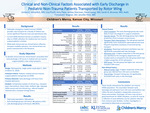
Objective: Helicopter emergency medical services (HEMS) are crucial for transporting critically ill children to definitive care, however, rising costs and relative risks of this type of transportation necessitate careful evaluation of potential over-utilization. Current literature primarily focuses on pediatric trauma patients, leaving a significant gap in data regarding non-trauma pediatric HEMS transports and the influence of non-clinical factors such as referral hospital distance, resources, and capabilities on transport decisions. This study aims to address these gaps by examining non-trauma pediatric HEMS patients and identifying associated clinical and non-clinical factors related to early hospital discharge (< 24 hours). Methods: This retrospective, single-center study includes pediatric patients with medical and non-trauma surgical diagnoses transported by HEMS between April 1, 2021 and March 31, 2024. Clinical data were extracted from transport team records and the hospital’s electronic health records. Analyses were performed to identify factors associated with discharge within 24 hours of admission. To identify predictors of early discharge, we analyzed clinical factors including chief complaint, pre-transport vascular access, transport crew interventions (medication administration and procedures), respiratory assistance, and Pediatric Age-Adjusted Shock Index (SIPA) scores. Additionally, we examined the impact of the initial admit unit, and medical support required within the first 24 hours of hospitalization. Non-clinical predictors included the referring hospital’s status (critical access and/or rural designation) and the time of transport. Results: A total of 568 patients were transported by HEMS, of whom 88 (15%) were discharged within 24 hours. Patients in the early discharge group were more likely to present with neurologic chief complaints (40%), whereas those remaining hospitalized beyond 24 hours more frequently presented with respiratory complaints (40%). Normal SIPA scores both prior to and at the conclusion of transport were significantly associated with early discharge (p=0.012 and p=0.011, respectively). Furthermore, patients requiring no medications or respiratory assistance during transport, or no respiratory support within the first 24 hours of admission, were significantly more likely to be discharged early (p< 0.001). Notably, all patients with central access prior to transport remained admitted for more than 24 hours (p=0.004). Regarding non-clinical factors, patients transported from designated rural hospitals were more likely to experience early discharge (p< 0.001). Conclusion: These results characterize the pediatric non-trauma HEMS population and identify key predictors of early hospital discharge. This data is essential for developing standardized dispatch criteria to mitigate over-utilization and ensure high-acuity transport is reserved for the most appropriate patients.
Disciplines
Critical Care | Pediatrics
Recommended Citation
Mitzelfelt, Jordon; Pruitt, Lisa; Papa, Amy; Sherman, Ashley K.; Juang, David; Brunner, Sarah; Wagner, Asdis Finnsdottir; and Flint, Jennifer, "Clinical and Non-Clinical Factors Associated with Early Discharge in Pediatric Non-Trauma Patients Transported by Rotor Wing" (2026). Posters. 506.
https://scholarlyexchange.childrensmercy.org/posters/506



Notes
Presented at the 34th Annual Critical Care Transport Medicine Conference (CCTMC); Orange Beach, Alabama; April 13-25, 2026.